Showing posts with label law. Show all posts

Friday, April 4, 2014

What is a class action?


You may have been in a situation of feeling hopeless in winning a court case due to how big you were up against. If this was the case and there were several others with claims similar to yours, your case would have made a dent if you were part of a class action.

Image Source: gigaom.com

Lawsuits might make you a bit uncomfortable or simply confused, and the most natural course of action is to ask someone who knows something about legal turns or Google about it. Class action is used in civil litigations to allow multiple parties to file a case based on the same legal grounds.

This type of litigation is normally applied when a person is going against big conglomerates or private entities which are assumed to employ the best legal services. A class action gives all claimants better chances of receiving compensation, and as part of this legal recourse, you can figure out the next steps legal procedures more easily than if you were doing it alone.


Image Source: injuryattorneyar.com


One of the biggest benefits of class action is the distribution of legal costs. Lawsuits are expensive and you simply wouldn't want to go through judicial hoops if your claim for damages is relatively small. If you are involved with a class, you can get a justified claim depending on the rule of the courts.

Another is that individual suits are done on a first-come, first-served basis. If you have several complainants ahead of you and their claims are much larger than yours, you might end up facing a bankrupt company by the time you get your turn. With class action, the damages are justifiably spread to all members.


Image Source: fastweb.com


You can try to fight alone at any given time, but if you can find other people to help your case, it will always be the best solution to take.

Evan Granowitz
is a versatile lawyer who specializes in class action and other types of civil litigation. Get to know more about the law by visiting this website.

Tuesday, March 11, 2014

REPOST: Pitt, Duquesne Law schools rise in U.S. News rankings

U.S. News and World Report released its latest list of the best law school across America, with University of Pittsburgh and Duquesne University moving up the list, as compared to last year's rankings. Read more from this article:
***
Both the University of Pittsburgh Law School and Duquesne University School of Law moved up significantly in the annual ranking by U.S. News and World Report, released Tuesday.
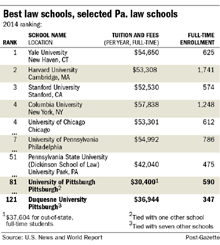
Pitt, which dropped in last year's ranking from 69th to 91st, moved up 10 spots in the latest survey to No. 81, tied with nine other law schools.
Duquesne, which made the list last year for the first time in a decade, coming in at No. 144, moved up to No. 121 on this year's list, in a five-way tie.
The dean of Duquesne’s law school said the university’s improved ranking is likely due, at least in part, to its consistency in a time when many law schools are struggling to maintain class sizes.
“We made a conscious decision, with the strong support of the university, that we weren't going to sacrifice our high standards just to fill seats,” said Ken Gormley. “That has financial ramifications, but we stuck to our guns and decided to stay focused on our mission of developing educated, ethical lawyers.”

(Click image for larger version)
The report, which uses criteria including students' acceptance rates, job placement rates and law school admission test scores, examined 194 accredited schools.
U.S. News and World Report doesn't immediately provide all the data behind a school’s ranking, noted Pitt Law School Dean William Carter, so it’s hard to be certain about why any given school fared the way it did.
But, he said, the jump in Pitt's ranking probably can be attributed to its increased job placement success and the fact that the school held its median scores steady on the law school admission test, or LSAT.
Yale University topped the list for the second year in a row, followed by Harvard, Stanford, Columbia and the University of Chicago.
As for how significant the rankings are for students choosing a law school, Mr. Gormley said most prospective students are aware of the U.S. News numbers. “But I think in most cases, they are sophisticated enough to figure out much of this is a PR tool,” he said. “Most professional schools’ reputations, unless you’re Harvard or Yale, are regional. But [the rankings] do contribute to developing an image both regionally and nationally.”
Mr. Carter said while he was “gratified” that Pitt had risen in the standings, it would not have an impact on what the school is already doing. “I remain resolute in my view that U.S. News rankings should never be treated as the single metric by which applicants evaluate a law school,” he said.
***
For more industry-related news about law, visit this Evan Granowitz blog site

Wednesday, December 4, 2013

REPOST: The essential cases every law student should know

From McLibel to Lord Denning's case, this article from The Guardian listed down the cases the every law student should know:

***

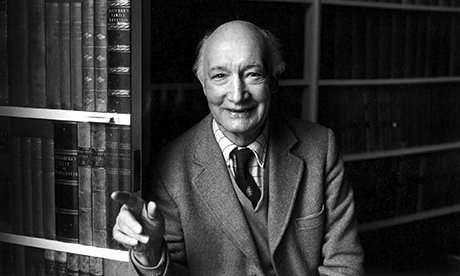
Image Source: theguardian.com

Cases capture human stories, shape public debate and establish new expectations of the state. Their wider effect can reflect society's consciousness but often lead to new laws. Cases and judges' decisions are a law student's bread and butter. Here are a few you will come across:

Care for thy neighbour:

In 1932 Mrs Donoghue launched the modern law of negligence, after finding her ginger beer less than appealing. Known to generations of lawstudents as the "snail in the bottle" case, it is best known for Lord Atkin's famous neighbour principle. In declaring we should take reasonable care to avoid harm to those we foresee can be affected, he established when we owe duties to each other. Accidents and injuries were forever to be reshaped into claims and compensation.

Foreign detainees

Known as the Belmarsh decision, there is no modern case that better sets the boundary between national security and civil liberties. Decided by a panel of nine law lords, the 2004 decision became an important milestone in judges protecting both the rule of law and human rights. In a challenge to the Labour policy of indefinitely detaining foreign terrorist suspects without charge, the majority declared the British state acted illegally and in a discriminatory way. In his powerful rejection, Lord Hoffman stated "The real threat to the life of the nation… comes not from terrorism but from laws such as these."

Spanish fisherman

Providing the legal backdrop to a decade of EU-scepticism is the 1991 case of Factortame, this case on the rights of Spanish fisherman to fish in British waters is a mainstay on any public law course. It confirmed the priority of European laws over UK acts of parliament and thus struck a blow against parliament's legal supremacy. In so doing it provoked much constitutional debate about the extent of EU legal powers - and Britain's relationship with Europe as a whole.

McLibel

Officially the longest case in English legal history, this ten year David v Goliath libel battle exposed the price of justice when corporations take on individuals. The fast food giant sued green campaigners David Morris and Helen Steel for libel over a stinging pamphlet criticising the their ethical credentials. McDonalds walked away with both a win and a PR disaster. The European court of human rights later declared in 2005 that the pair, who were unfunded and were representing themselves, had been denied their right to a fair trial.

Jodie and Mary

In the year 2000 the plight of conjoined twins made front page news. The question was whether it was justified to separate and knowingly "kill" the weaker Mary in order to save her stronger sister Jodie, given both were destined for a premature death. In spite of parents favouring non-separation, doctors wanted a declaration that such an operation would be lawful. In a maze of ethical and legal conflicts, Lord Justice Wardrather hollowly declared that "this is a court of law, not a court of morals."
After admitting to sleepless nights, the judges allowed the doctors to separate. Lord Justice Brooke declared the situation as one of necessity, allowing the option of a lesser evil. The stronger twin survived and made a full recovery. The thankfully rare case, otherwise found in philosophy debates, demonstrates the relationship between law and morality, perhaps one of the first questions on a legal theory course.

Domestic abuse

A year after marital rape was declared rape in 1991, came the case ofKiranjit Ahluwalia, who had been abused for over a decade by a violent husband. She was convicted of murder after setting her husband alight as he slept. In recognising long-term domestic abuse and the possibility of a slow-burn anger that led to her snapping, the case was a cause célèbre for feminist and domestic abuse groups. Though finally the decision in the end was based on diminished responsibility, it was seen as a benchmark for tackling the gender bias in the criminal law and raising public awareness of domestic abuse. Ahluwalia's conviction was reduced to manslaughter, and she was freed.

Pinochet

International human rights law received a global TV audience in 1998 after former Chilean dictator General Pinochet was arrested in London. Under the rules of universal jurisdiction, he was detained following a Spanish extradition request facing charges of crimes against humanity. The law lords declared that there could be a limit to the immunity enjoyed by heads of states. Though Pinochet was never extradited, the case sent out a strong message about accountability for leaders who commit human rights abuses,before the international criminal court was established.
The case is also well known among lawyers when after the first hearing it was disclosed that that one of the ruling law lords, Lord Hoffmann, was a director of Amnesty International, a party to the cases. The entire hearing had to be repeated to show that "justice must not only be done but be seen to be done."

The internet age 

Injunctions, twitter, privacy and the extra marital activities of footballers were all the rage in early 2011. Nothing struck up more attention than theapplication for an injunction by Ryan Giggs against the Sun. His name was widely tweeted and the situation became more farcical when MP John Hemming revealed his name in the House of Commons. The debate forced the law to react to an age of the internet and social media. The case followed a long line of celebrity court battles in the 2000's, and became another marker in the debate between balancing freedom of expression and the right to a private life.

Roe v Wade 

From across the Atlantic arguably no case better demonstrates the political and social impact of judicial decisions. The landmark decision in 1973 upheld a woman's right to an abortion. Synonymous with abortion in the USA. Hundreds of thousands march on the US supreme court on the anniversary of the decision each year.

Any of Denning's cases 

In our common law system, many judges leave their mark on a particular area of law. However clichéd, no judge will live longer in the memory of law students than the controversial Lord Denning. He demonstrates the power of personality in a subject that is often seen technical, dry and rule-based. In the words of Lord Irvine, "the word Denning became a byword for the law itself." Denning reminds us that all cases are eventually decided by individuals who are made up of values and personal perspectives that make them who they are. Students, you are encouraged to think, debate and learn the law in the same spirit. Good luck.

***
This Evan Granowitz Facebook page contains more related news and updates about law.

Thursday, November 7, 2013

REPOST: Stop-and-frisk judge fights removal from case

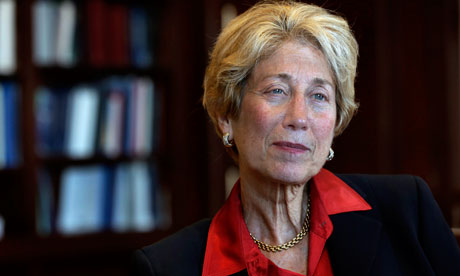
Read what Judge Shira Scheindlin fights for from this The Guardian article:

***

Image Source: theguardian.com
A US judge has asked an appeals court to reinstate her to a closely watched case regarding the constitutionality of the New York police department's "stop-and-frisk" tactic, saying she was unfairly removed from it a week ago.

In a highly unusual request, US District Judge Shira Scheindlin asked the 2nd US circuit court of appeals to reverse its ruling of 31 October when a three-judge panel removed her from the case, saying she "ran afoul" of the judicial code of conduct in part by granting media interviews.

Two months ago Scheindlin became a hero of civil rights and civil liberties groups when she struck down parts of stop-and-frisk, ruling that it amounted to "indirect racial profiling" that resulted in the disproportionate and discriminatory stopping of black and Hispanic people.

In that ruling she also appointed a federal monitor to oversee changes in NYPD practices.

The city appealed and the appeals court ruling last week to remove her from the case and to freeze her decision was at least a temporary victory for Mayor Michael Bloomberg and the NYPD. The city has argued that stopping, questioning and frisking suspicious people has led to a steep decline in crime rates.
The issue played a role in the campaign for mayor of New York City in which candidate Bill de Blasio, who won in a landslide on Tuesday, blasted stop-and-frisk as unfair.

The three-judge panel's ruling had no implications for the merits of the case and instead was a rebuke of Scheindlin. The judges said they would rule on the merits of the case upon hearing the city's appeal of Scheindlin's ruling next March.

Scheindlin, in the motion filed on Wednesday by her attorney, Burt Neuborne, noted that the judge had never been accused of running afoul of the code of conduct by any of the parties in the case at the district court level, nor in oral arguments before the appeals court.

Moreover the appeals court should have notified Scheindlin in advance that it intended to disqualify her and she should have been given a chance to respond before the ruling was made, her lawyer said in the court brief.
"Since nobody asked for her disqualification, and the disqualification came from the court itself, this is her chance to ask: 'Before you do this to me, let me at least get a chance to explain myself,'" Neuborne told Reuters.

***
More legal issues and updates can be found in this Atty. Evan Granowitz Facebook page.

Friday, September 27, 2013

REPOST: Michael Jackson death trial: Jury to resume deliberations Friday

Is the case of Michael Jackson's wrongful-death slowly coming to a close? Read the latest on this issue from this CNN article.


***

Los Angeles (CNN) -- Jurors began deliberations Thursday in the Michael Jackson wrongful-death trial, potentially bringing the contentious case to a close after five months of testimony and three days of closing arguments.

The 12 jurors spent two hours in the jury room Thursday afternoon before ending their day; they will return Friday morning for more deliberations.

Katherine Jackson's lawyer delivered his final arguments in the AEG Live trial Thursday morning, delivering his rebuttal to defense closing arguments.

AEG Live's Marvin Putnam had asked jurors to find Michael Jackson responsible for his death, not the company that promoted and produced his comeback concerts in 2009.

Jackson's mother and three children are suing AEG Live, contending the company was liable in the pop icon's drug overdose death because its executives negligently hired, retained or supervised Dr. Conrad Murray.

"Plaintiffs want you to hold a concert promoter liable for Michael Jackson's overdose in his bedroom at night, behind locked doors on June 25, 2009," Putnam told jurors. "An overdose of the drug administered to Mr. Jackson by his longtime doctor -- Dr. Murray -- who he'd been seeing for years, a doctor he brought to Los Angeles from Las Vegas."

"How dare they come up here and accept no responsibility and blame it all on Michael," Jackson lawyer Brian Panish said in his rebuttal.

Panish suggested that Jackson's share of blame was 20%, "but the rest goes on AEG."

When the trial began five months ago, Putnam warned he would show "ugly stuff" and reveal Jackson's "deepest, darkest secret."

The revelations that jurors heard from 58 witnesses over 83 days of testimony spanning 21 weeks included details of Jackson's drug use and his shopping for a doctor to give him the surgical anesthetic propofol that he thought would give him sleep.

"He was nearly half a billion dollars in debt," Putnam argued Wednesday. "His mother's house was near foreclosure, we didn't know that then. What else do we know now? That Mr. Jackson spent decades shopping for doctors to give him the painkillers he wanted. Mr. Jackson made sure we didn't know that."

Panish, the lead Jackson lawyer, conceded in his closing Tuesday that the singer may have some fault for his own death, but said "it's about shared responsibility."

Jackson did use prescription painkillers and was warned that using propofol at home to sleep was risky, "but he never had a problem until Dr. Conrad Murray was working and until Conrad Murray negotiated with AEG Live," Panish argued.

Who's to blame for Michael Jackson's death?

The AEG Live lawyer argued Wednesday that Jackson should take the full blame. "The sad truth is Mr. Jackson's death was caused by his choices and it would have happened no matter what -- with or without AEG Live."

The Jackson lawyer urged jurors to award the family between $1 billion and $2 billion in damages for what he called AEG Live's share of liability in Jackson's death -- to replace what Jackson would have earned touring, had he lived, and for the personal suffering from the loss of a son and father.

Putnam told jurors Wednesday that was "an absurd number."

Katherine Jackson testified that she filed the wrongful death lawsuit three years ago against AEG Live "because I want to know what really happened to my son."

Murray was convicted of involuntary manslaughter in Jackson's propofol overdose death.

The judge is allowing a television camera in court for the closing arguments and verdict.

Lawyer: Blame Jackson for his death, not AEG Live

Burden of "Poof"

Panish -- a former college football player who has a reputation for winning large damage awards -- appeared more aggressive in his rebuttal than in his initial closing arguments delivered Tuesday.

In what may become a much-repeated video highlight, Panish joked about how his AEG LIve counterpart had accused him of making up the estimate of $59 million that MIchael Jackson could have been expected to have given his mother and children in support had he lived.

"Poof! Poof! I just made it up!" Panish said dramatically as he pointed to Putnam, sitting at the AEG Live defense table. The line and gesture drew a laugh from some jurors.

Panish showed jurors that the figure was actually from a opinion provided by a financial expert that AEG Live hired to analyze the issue.

Putnam, in his closing Wednesday, referenced the expert's lower-end estimate of $21 million. The numbers could be important in guiding the jury if it decides to award damages to the Jacksons.

AEG Live's defense

Murray treated Michael Jackson and his children for minor illnesses while they lived in Las Vegas for three years, before the singer returned to Los Angeles to prepare for his "This Is It" comeback tour. It was Jackson -- not AEG Live executives -- who chose Murray to be his full-time doctor for his tour, the company's lawyers contend.

AEG Live Co-CEO Paul Gongaware negotiated to pay Murray $150,000 a month only because of Jackson's request to have his doctor with him as he performed 50 shows at London's O2 Arena, they argue.

"He told them 'We're bringing this doctor,' " Putnam said. "This was a choice Mr. Jackson made. He was a grown man."

AEG Live executives tried to talk Jackson out of taking an American doctor with him on tour, suggesting he could save money by using a physician in London, Putnam said.

"But Mr. Jackson was undeterred," he said. "Ultimately, it was his money, his doctor, his choice. He certainly wasn't going to take 'no' for an answer."

There was no need to check Murray's background because he was a licensed, successful doctor who was known to Jackson, Putnam said. "All AEG Live knew was Dr. Murray was Mr. Jackson's longtime doctor."

A key argument in the Jackson case is that AEG Live was negligent by not ordering a financial background check of Murray, which would have revealed he was in a dire financial situation and not successful. His desperation to keep his lucrative job led Murray to violate his Hippocratic Oath to do no harm by using the dangerous propofol infusions to put Jackson to sleep each night for two months, Jackson lawyers argue.

AEG Live executives had no way of knowing Murray was treating Jackson's insomnia with propofol in the privacy of his bedroom, their lawyers contend. Jackson was a secretive addict, adept at keeping family, friends and other doctors in the dark about his medical treatments, they argue.

But two doctors testified that they told Gongaware about Jackson's abuse of painkillers and his insomnia during tours in the 1990s, when the AEG Live executive served as tour manager. Jackson lawyers argue Gongaware, who was the top producer on the new tour, should have known that Jackson could suffer the same problems in 2009.

The deterioration of Jackson's health over the two months he was being treated by Murray was a red flag that there was a problem, but AEG Live executives negligently ignored the warning, Jackson lawyers argue. By June 19, he was frail, suffering chills, unable to do his trademark dances and paranoid, according to testimony.

"Everyone believed at the time that a 50-year-old man, who hadn't performed in a decade was tired, out of shape and very nervous," Putnam argued Wednesday. "That's what they believed at the time and it makes sense."

AEG Live would avoid a negative verdict if it is able to convince at least four of the 12 jurors that it did not hire Murray. It is the first of 16 questions on the jury verdict form. If jurors answer it with a "no" -- that AEG Live did not hire the doctor -- they would end their deliberations and the trial.

An AEG Live lawyer e-mailed an employment contract to Murray on the morning of June 24, 2009. Murray signed it and faxed it back to the company that day. But the signature lines for AEG Live's CEO and for Michael Jackson were never signed since Jackson died the next day.

But Panish, the lead Jackson lawyer, told jurors Tuesday that all the elements of an oral contract -- "just as valid as a written contract" -- were in place when Jackson died.

Murray had been treating Jackson for two months and the written contract stated that his start day was May 1, 2009. A series of e-mail exchanges involving Murray and AEG Live executives and lawyers support this argument, Panish said.

A look at the life of Michael Jackson

Blame and damages

If the jury concludes AEG Live has liability, it would have to decide how much the company should pay in economic and personal damages to Jackson's mother and children. They can use estimates of Jackson's "lost earnings capacity" -- the amount of money he could reasonably be expected to have earned if he had lived -- to guide them.

AEG Live expert Eric Briggs testified it was "speculative" that Jackson would have even completed another tour because of his drug use, damaged reputation and history of failed projects. He suggested the star may never have earned another dime.

Putnam's closing argument about damages must overcome the impression left on jurors Tuesday, when Panish played a video montage of Jackson performances.

"That is, I think, the best evidence of if Michael Jackson could have sold tickets -- not what Mr. Briggs would tell you," Panish told jurors.

Panish suggested jurors pick a number between $900 million and $1.6 billion for economic damages. They should add on another $290 million for non-economic damages -- or personal damages, he said.

Putnam argued that the number, if the jury finds AEG Live liable, should be closer to $21 million, the amount of money AEG Live's expert calculated Jackson would have given his mother and three children over the next 16 years. He couldn't have given them more because he had a $400 million debt that was getting deeper, he said.

"If Mr. Jackson had lived, it's hard to see how he would ever have dug himself out of that whole," Putnam said.

The last question on the verdict form asks jurors to assign a percentage that they believe represents Michael Jackson's share of blame in his death. The total damages owed by AEG Live would be reduced by that percentage.

While AEG Live lawyers did not suggest a percentage, Panish suggested jurors reduce the damage award by 20% to reflect Jackson's share of blame.

Michael Jackson's mom remembers her 'sweet little boy'

***

More legal issues and news are shared in this Evan Granowitz blog site

Friday, September 20, 2013

Repost: Task Force Backs Changes in Legal Education System

A report that takes a look into the practice of most law schools in terms of providing little aid to needy students is currently in the works. Read this New York Times article for the details.
***

Faced with rising student debt and declining applications to law schools, a task force of the American Bar Association is calling for sweeping changes in legal education, including training people without law degrees to provide limited legal services and opening the bar to those who have not completed four years of college and three years of  law school.
The report, to be issued on Friday, does not refer specifically to President Obama’s suggestion last month that law schools mightlimit classes to two years, and have students spend their third year clerking or practicing in a firm. But it did recommend the elimination of the rules that law students must have 45,000 minutes in a classroom to graduate and that they cannot get credit for field placements that are paid.
The report describes an urgent need for change in the nation’s legal education.  
“The system faces considerable pressure because of the price many students pay, the large amounts of student debt, consecutive years of sharply falling applications, and dramatic changes, possibly structural, in the jobs available to law graduates,” it said.  “These have resulted in real economic stresses on law school, damage to career and economic prospects of many recent graduates, and diminished public confidence in the system of legal education.”
It called  the predicament of the many recent graduates who may never get the kind of jobs they anticipated  “particularly compelling.”
The report is still a draft, to be distributed for comment, then considered at the bar association’s 2014 meeting. If adopted there, it will be influential but not binding on either law schools or state bar associations.
Randall T. Shepard, the former Indiana chief justice who was chairman of the task force, said that within the group, the most controversial sections were those dealing with how legal education is financed and with the accreditation standards.
The report criticizes the practice of most law schools to provide little aid to needy students, reserving most of their scholarships for those with the highest credentials in part to help raise the school’s rankings.
“There were very prickly long discussions about whether the language in the report accurately describes the situation,” Mr. Shepard said. “The other issue where there was real disagreement was on the list of items in the accreditation standards that we thought should be liberalized or eliminated.”
Among the items on the list are  the standards on credit  for  work  before law school matriculation, distance education, student-faculty ratios, the proportion of courses taught by full-time faculty, tenure, physical facilities and more.
The overall idea, said James. B. Kobak Jr., a New York lawyer on the task force, was to free law schools to be more innovative and get away from the one-size-fits-all model.
But Leo P. Martinez, a task force member who is president of the Association of American Law Schools, said that while he generally embraced the idea of encouraging heterogeneity among law schools, he thought the standards helped to ensure an “irreducible minimum of quality.”  
Mr. Shepard said that there had been little controversy over the use of  nonlawyer practitioners, in part  because the members were so impressed by Washington State’s experiment with limited-license legal technicians, trained and licensed to handle certain civil legal matters. That program’s success has led to an expansion to practitioners for domestic relations, an area in which many of those who come to court are now unrepresented.
The report, citing the wide variety of colleges in the United States, called for more differentiation and experimentation by law schools.  It  also recommended the  creation of national standards for admission to the bar.
***
Interesting news and articles on the legal arena can be found in the Evan Granowitz blog site

Tuesday, August 27, 2013

REPOST: Eastman Kodak wins approval of bankruptcy reorganization plan

 Judge Allan Gropper overruled objections in favor of Eastman Kodak, making the company win approval of a bankruptcy reorganization plan.  Read this Forbes Magazine article for details:

Eastman Kodak won bankruptcy-court confirmation of its reorganization plan at a hearing in Manhattan this afternoon, after Judge Allan Gropper overruled a handful of remaining objections from shareholders and the U.S. Trustee.

Image source: Forbes.com

Kodak creditors voted overwhelmingly in favor of the plan last week. The company, which filed for bankruptcy in January 2012, expects to emerge from Chapter 11 by Sept. 3.

Reorganized Kodak will be “a very different company than the one in the popular imagination, and a very different one than the one that filed for bankruptcy,” Kodak lawyer Andrew Dietderich, a partner at Sullivan & Cromwell, told Judge Gropper this morning. Since its bankruptcy filing, the iconic 121-year-old company auctioned its digital-imaging-patent portfolio for $527 million and sold its personalized-imaging and document-imaging business to the U.K. Kodak Pension Plan for $650 million. A streamlined Kodak will focus, post emergence, on its commercial-imaging business.

Kodak entered Chapter 11 last year with $6.75 billion in liabilities and assets of only $5.1 billion. The company blamed its financial woes on four main problems – the economic recession of 2008, costly retiree benefits, withering returns from its intellectual-property-licensing efforts, and strains on trade credit in the wake of negative publicity.

“Its decline and bankruptcy is a tragedy of American economic life,” Judge Gropper said today as he read aloud his opinion.

The company traced the demise of its traditional film business back at least a decade. As consumers shifted to digital photography, Kodak’s revenue declined from about $13.3 billion in 2003, to about $6 billion in 2011. During that same period, Kodak’s global workforce shrank from about 63,900 employees, to about 17,000.

Recoveries
Under Kodak’s reorganization plan, $375 million in second-lien claims will receive 85% of the reorganized company’s equity, subject to dilution under a new equity plan and certain conversion rights granted to the retiree committee in the case. In addition, second-lien holders will receive cash for any accrued and unpaid interest through the reorganization plan’s effective date.

Based on Kodak’s projected equity value of $441 million for the reorganized company, second-lien recovery is pegged at 100%, although holders are nonetheless considered “impaired” under the plan and were allowed to vote.

The remaining 15% of the equity in the reorganized company will be contributed to an “unsecured creditor pool” that would be distributed, on a pro rata basis, to holders of the company’s general unsecured claims and unsecured claims arising under a settlement with retirees that was reached in October 2012.

Kodak will set aside about $1.8 billion for allowed general unsecured claims, Dietderich said this morning, a recovery of about 4-5%. Retiree settlement unsecured claims are $635 million. The company’s current equity will be wiped out.

Kodak conducted a $406 million rights offering for unsecured creditors that will fund cash distributions to second-lien noteholders, backstopped by GSO Capital Partners, Blue Mountain Capital, George Karfunkel, United Equities Group, and Contrarian Capital.

Under the rights offering, holders of general unsecured claims and holders of retiree claims were offered the right to purchase up to 34 million shares of the reorganized company at $11.94 per share. Up to six million of those shares were offered to unsecured creditors as so-called “Section 1145 rights” under a provision of the bankruptcy code that allows new securities to be exchanged for claims. The remaining shares, including any unsubscribed Section 1145 rights shares, were offered to holders of unsecured claims and retiree claims who are “accredited investors” or “qualified institutional buyers” in order to qualify under certain securities registration exemptions.

Kodak’s ultimate value became a major point of contention during the hearing today, as a handful of shareholders made a last-ditch effort to convince Judge Gropper that the company is actually worth far more than it claims. Gropper allowed one shareholder to question Kodak’s valuation experts from Lazard, but gave him a short leash. Last week, Gropper denied a motion filed by shareholders seeking the formation of an official committee to represent their interests. It was the second time Gropper had denied an equity committee, with professionals funded by the estate.

Looking ahead, Kodak has said it anticipates “stabilization and then growth in revenue with a commercial imaging EBITDA improvement of approximately $327 million between 2013 and 2017.”

Kodak has said its commercial-imaging EBITDA improved by approximately $106 million between 2011-2012, explaining, “the significant improvement in EBITDA is a result of both Kodak’s increase in the installed base of new products introduced in the last four years and the effect of its accumulated annuities plus a strong focus on new growth markets and new product introductions that drive higher gross profit, as well as the concerted actions to reduce corporate cost structure through extensive partnerships and resource realignment.”

More specifically, the company projected operational EBITDA of $199 million for 2014, $282 million for 2015, $360 million for 2016, and $494 million for 2017, on gross profits for those years of $539 million, $628 million, $737 million, and $898 million, respectively.

The company has estimated that post-emergence, it will have a global cash balance of $815 million. Kodak CEO Antonio Perez will continue to serve as CEO for up to one year following emergence, or until the company’s new board names a successor. – John Bringardner/Alan Zimmerman

Bankruptcy litigation is one among the many areas of expertise of Atty. Evan Granowitz.  Visit this Facebook page for more information. 


Tuesday, July 16, 2013

REPOST: Home buyers must perform their own due diligence


This Los Angeles Times article answers a condo buyer’s question regarding a loan taken out by the homeowner association’s board of directors.

Question: Our homeowner association's directors have attorneys telling them they can do whatever they want because they are the board. Distrusting the board, I went to the office to inspect documents and found an agreement dated February 2007 for a loan for more than $3.3 million the board had taken out without the knowledge of owners. I purchased my condominium in 2007 after the loan was taken out. I believe that this obligation should have been disclosed during my purchase.

While in escrow, I had only two weeks to review my condo documents, which stated, among other things, that there was $2.05 million in reserves. That was confirmed by the association's manager. There was no mention of the loan proceeds.

I feel I was deceived in the purchase. Do I have any recourse against the association, the board of directors or real estate agents?

Answer: Boards are not free to do whatever they want. Their attorneys should be telling directors what they can legally do and what they are prohibited by law from doing. Attorneys and boards are limited by the law and by the association's governing documents. Being on the board is not justification for breaking the law, and attorneys can be disbarred for recommending actions that violate the law. That does not mean boards are prohibited from taking loans secured by the common property, but the actions must be authorized by the governing documents.

Those purchasing any property in a common-interest development need to read and understand the association's governing documents and how the restrictions will apply to them long before signing the final papers. Smart buyers perform due diligence well in advance of signing a purchase agreement. Providing those documents well in advance of closing should be a precondition to any sale. Leaving little time for review before the closing of escrow should be a red flag of potential problems at that association. What these documents cannot disclose is how your board will act.

The loan should have appeared in the association's pro forma budget, where a buyer performing due diligence should have discovered it. But it is the buyer's duty to ask for and the seller's duty to disclose that assessment.

Civil Code Section 1368 lists documents buyers are required to receive before closing escrow, whether provided by the association or the seller. The association is not required to voluntarily disclose any loans or even any litigation involving the association. That failure does not make the association, its board or even the real estate agent liable to you. The onus for knowing what questions to ask, and to whom, is on the potential buyer.

The association may seek a separate assessment to pay off the loan, but titleholders may find selling or refinancing, although not prohibited, difficult while loans are outstanding. It is incumbent on buyers to perform their own due diligence before making an offer.

This Evan Granowitz Facebook page has links and updates on corporate litigation-related news and information.

Wednesday, May 29, 2013

REPOST: A Law That Keeps Gun Makers Smiling


This New York Times article reports the constitutionality of the Protection of Lawful Commerce in Arms Act - a law that grants a special shield around the gun manufacturers.


A line of tobacco executives stood in Congress one day in 1994 with their right hands raised, just before they swore, one by one, that they did not believe nicotine was addictive.

They looked miserable: within a few years, their companies would be paying out hundreds of billions in damages for the illnesses caused by smoking.

For happier faces, you could look at a picture taken in the Oval Office when President George W. Bush signed a bill in 2005. Surrounded by beaming gun manufacturers, Mr. Bush put the final touch — his signature — on a piece of legislation that would make it very difficult for anyone hurt by gun violence to sue the makers for injuries.

And why wouldn’t they be smiling?

The law signed that day, the Protection of Lawful Commerce in Arms Act, has smothered lawsuits by cities around the country, including by New York, that sought to force manufacturers to be more careful in how they sold and distributed guns.

Under President Obama, the Justice Department has continued to line up with gun manufacturers to defend the constitutionality of the law.

Last year, a state court threw out a lawsuit by Daniel Williams, of Buffalo, who, as a high school junior, was mistaken for a gang member and shot by a Saturday-night special — a Hi-Point 9-millimeter semiautomatic pistol, manufactured by the thousands by Beemiller Inc. of Ohio.

The sole distributor of the Hi-Point, a man named Charles Brown of MKS Supply, “has sold at least 630 handguns traced to crime in the State of New York,” according to the lawsuit.

Like many others in the manufacture and distribution of guns, Mr. Brown has shown little curiosity about how the weapons were used. An article in The New York Times on Tuesday reported that numerous gun executives stated during sworn depositions that it was not important for them to keep track of how often their guns were used in crimes.

For instance, Mr. Brown said that he never examined the “trace” requests that came from law enforcement to see which of the companies that he supplied were, in turn, selling guns that ended up being used in crimes.

Time after time, the executives said they were not concerned with finding out what happened to the guns.

All these statements were made in lawsuits brought before the 2005 law put up a special shield around the gun manufacturers. The law grants an exception for manufacturers or distributors who are accused of having knowingly violated state or federal laws. Because of that exception, a state appellate court in October restored the suit brought by Mr. Williams against Hi-Point, Beemiller, MKS Supply and others. (The owner of Beemiller, Tom Deeb, has said that law enforcement authorities have recognized him for the special help he has given in investigations.)

The Williams lawsuit is one of very few cases not eliminated by the law.

Before the law’s passage, a federal judge in Brooklyn hearing a case brought by the N.A.A.C.P. found that gun manufacturers and distributors were not doing simple things that would reduce the number of weapons available to criminals. As examples of what could be done, wrote the judge, Jack B. Weinstein, manufacturers could only allow their products to be distributed to retailers who had actual storefronts, carried insurance, keep a minimum inventory, and allow the manufacturers to review their books.

Such measures would not restrict any Second Amendment rights, the judge ruled, and the evidence showed that “more prudent and easily available merchandising practices on the part of the defendants would have saved many lives in the past — and would save many in the future.”

Why weren’t these steps being taken?

“Some members of the industry believe that unified, well-organized voluntary attempt to limit diversion of guns to criminals would be the equivalent of a public recognition of failures to take such steps in the past,” Judge Weinstein wrote, “with an implied responsibility for thousands of avoidable deaths.”

What to make of the Department of Justice under President Obama? “We hope they will change their view on the constitutionality of a federal law that effectively rewrites state’s civil justice laws to protect one industry,” said Jonathan Lowy, a lawyer with the Brady Center who has brought many cases against gun manufacturers.

Allison Price, a spokeswoman for the Justice Department, said: “We continue to defend the constitutionality of this law. While the Newtown tragedy does not alter the department’s view regarding the constitutionality of the statute, it does underscore the need for new gun legislation, as the president and attorney general have said.”

The gun makers can still smile about the 2005 law.

Depending on how you handle conflicts, resolving them can either be easy or complicated. See this Evan Granowitz Facebook page to help you deal with your legal conflicts. 

Wednesday, January 2, 2013

Video deposition formats - what they are and how to choose


Read this HG.org article about the variety of video formats that attorneys can choose from should they wish to have a copy of the video deposition.


This article was written to help explain the various video formats available to attorneys after conducting a video deposition.

At the end of a video deposition, a videographer usually asks counsel if they would like a copy of the video and in what format. Nine times out of ten, they have no idea that they even have a choice of format, not to mention the difference between mpeg-1 and mpeg-2 (that is, if they even know they want it in the first place!). In an effort to edify and illuminate a fairly esoteric topic, I put together a list of the most common video formats along with their corresponding strengths, weaknesses, advantages and disadvantages.

DVD/VOB 

This is your standard DVD disc. Quality can vary depending on the videographer’s settings but it is typically standard definition with little to no compression. These discs have title menus and are playable on set-top DVD players and in computers. I only mention VOB because we occasionally get requests for VOB formatted video which is essentially synonymous with DVD.

• Advantages: High quality video. Universally compatible in all DVD players

• Disadvantages: Extremely difficult to edit/make clips. Long loading time. Must be stored on a disc (can’t upload to a hard drive for quicker access and archival purposes).

MPEG-2

This is the raw, uncompressed, high-quality format that is used to author DVD/VOB discs. It is essentially the same thing as a DVD, except without menus.

• Advantages: High quality video. More easily editable. Can be made into a DVD or MPEG-1*. Can be stored easily on a hard drive. Can be synchronized with transcript and exhibits.

• Disadvantages: Requires video editing software to edit. Limited compatibility. Will not play in a set-top player and requires a special codec for playback on Window Media Player. Large file size requires approximately one disc per deposition video tape. So, for an all-day deposition where seven tapes were used, you will receive seven discs even though they are not authored DVDs.

MPEG-1

This is a compressed or “lossy” format. Although resolution is degraded, the tradeoff comes in the form of drastically increased compatibility.

• Advantages: Can be played on essentially any computer without requiring additional codecs in programs like Windows Media Player, QuickTime and RealPlayer. Smaller file sizes require less storage space. An entire day’s worth of videos can typically fit onto one DVD. Quicker load and response times. Best format for synchronized depositions.

• Disadvantages: Degraded video quality… that’s about it! I hope that was helpful. If you are still in need of further explanation, please don’t hesitate to contact our video department. We are happy to help!

Source: http://www.hg.org/article.asp?id=29197

Sunday, December 16, 2012

What to expect from your lawyer


Many people do not have their own lawyers to represent them in court. Some only hire a legal representative when the need arises, hence many people do not know what to expect from an attorney-client relationship.

Lawyers owe certain duties to their client. Such duties include the duty of confidentiality, duty to avoid conflicts of interest, duty to represent the client, and duty to provide competent representation.

The duty of confidentiality simply means that lawyers ought to keep everything that have transpired and will transpire between his or her client a secret. Information about the client’s affairs must be confidential and must not be used by other people unauthorized by the client.


Image credit: privatetrustees.com


To avoid conflict of interest, an attorney must see to it that the clients he represents do not conflict with the interests of each other. This, however, does not mean that a lawyer cannot represent someone whose business is in competition with the other client. Avoiding conflict means that if a lawyer negotiates a lease for Client X, he cannot represent Client Y who wants the same space.


Image credit: ciminellilaw.com


Representing the client means that lawyers should always represent the interests and point of view of their clients. But it does not mean that they can condone fraudulent actions.


Image credit: mamaliz.com


Last but not the least, lawyers should provide competent representation. They should make the client aware if they have the experience and expertise to represent the latter. If not, the lawyers should refer an attorney who could best represent the client.

More about Evan Granowitz and other related topics are available on Myspace.