Showing posts with label news. Show all posts

Saturday, March 22, 2014

REPOST: Colorado lawmakers working to close loopholes in legal marijuana law

This article from FoxNews.com talks about the efforts of Colorado lawmakers in resolving the issues surrounding the legalization of marijuana consumption in the State.

***

Months after the launch of legalized retail marijuana in Colorado, the state is still trying to better regulate the drug and close the loopholes. 
Gov. John Hickenlooper, as part of that effort, just signed a new law calling for uniform packaging of edible marijuana. In an effort to make those products less attractive or accessible to kids, they will have to be sold in opaque, childproof packaging. 
State Rep. Daniel Kagan, who co-sponsored the legislative fixes, explained: "We identified these problems and we sought to tighten it up, to make sure that marijuana is really kept for adult use and kept away from under-aged persons and especially from toddlers." 
Kagan added, "We do it differently in Colorado. Everybody came together on this."
Children's Hospital, based in Aurora, has weighed in on the legislative efforts -- reporting an increase in emergency room visits and patient admissions from accidental exposure.  
Dr. Sam Wang, pediatric emergency physician, said symptoms range from basic sleepiness to more severe cases, where children have not been able to breathe properly and required breathing tubes. "As recreational marijuana goes forward, it's obviously going to increase availability and potentially increase unintentional exposures as well," Wang said. 
Other fixes signed by the governor on Monday include giving authority to pot shops to confiscate forms of identification, if they have reason to believe someone underaged is using a fake ID.  Another measure calls for local jurisdictions to submit fingerprints to the Colorado Bureau of Investigation (CBI) for the purpose of conducting fingerprint-based criminal record checks on people working in marijuana businesses.
State Sen. Linda Newell, a Democratic co-sponsor, acknowledged their work is not done. "We will probably find these clean-up bills as we go through the years after marijuana, both medical marijuana as well as recreational marijuana, has become a norm in Colorado," she said. 
The issue of stoned drivers is another trouble spot for state lawmakers. At a laboratory certified to test blood samples for marijuana, the director told Fox News there is not a roadside test, such as a breathalyzer, in the foreseeable future for determining if a driver is under the influence of cannabis. 
"One person may have a very high THC concentration in their blood, particularly medical marijuana users, and they're not affected. Where someone who has never smoked marijuana before, will have a much lower concentration and be very affected," said Dr. Robert Lantz, of Rocky Mountain Instrumental Laboratories.
According to state Marijuana Enforcement Division Public Information Officer Julie Postlethwait, Colorado has issued licenses to hundreds of vendors, including:
-- 183 retail stores
-- 238 retail cultivation facilities
-- 44 product manufacturers (i.e., edibles)
-- 4 testing facilities (for product potency and contaminants)
Dozens more are pending with the state in these categories. For those with state licenses in hand, they may not be open yet because they have to obtain paperwork at the local level, too.
Local permission can be thorny because Amendment 64, the state constitutional amendment which legalized recreational pot, left it up to municipalities in the Centennial State to decide whether to allow marijuana businesses within their borders.  
Dale Dyke and Chastity Osborn, a husband-and-wife team who converted their home into a bed and breakfast, complained that the "laws are very gray." Their business Get High Getaways was catering to marijuana tourists until the City of Lakewood ordered them to shut down the overnight stays. One complication is that while Colorado legalized recreational pot, the state left it illegal to use the drug outside in public or in traditional hotel rooms. For now, the couple is maintaining their location as a car service while working with investors to purchase a new location.
Recently, a marijuana job fair in Denver drew thousands of people with lines stretching a few blocks long. It has been referred to in local media reports as a "green rush."  
Visitors told Fox News they're moving to the state in hopes of finding jobs in the marijuana business. Shane Wylie and Matthew Bean are among them. They drove 1,300 miles from Louisiana, just in time for the fair.  
"This is our life-changing experience, this is our big step and career change," Wylie explained. Bean added, "I want to start from the bottom, so I can learn everything."

***
This Evan Granowitz blog site contains news and updates in and out of the legal arena.

Friday, February 28, 2014

REPOST: Court: School was within its rights to ban U.S. flag T-shirts on Cinco de Mayo

The court's verdict on the school that banned the use of U.S. flag t-shirts on Cinco de Mayo is out. Read about it from this CNN.com article. 

***


(CNN) -- A California school that stopped students from wearing American flag T-shirts on Cinco de Mayo didn't violate their constitutional rights, an appeals court ruled Thursday.

The school's approach, according to the appeals court, kept students safe in a climate of racial tension.

"The controversy and tension remained," a panel of judges from the 9th Circuit Court of Appeals said in their opinion, "but the school's actions presciently avoided an altercation."

School officials were worried about violence and disruption of school activities "and their response was tailored to the circumstance," the opinion said.

The case dates back to May 5, 2010, when the principal of Live Oak High School in Morgan Hill, California, asked a group of students wearing American flag T-shirts to turn their shirts inside out or take them off.

The students at the Northern California school refused, according to the appeals court's summary of the case, and later brought a civil rights suit against the school and two administrators, arguing that their rights to freedom of expression, equal protection and due process had been violated.

Judges said the civil rights case forced them to weigh the difficult question of what takes precedence: students' free speech rights or school safety concerns?

According to court documents, the incident occurred amid "ongoing racial tension and gang violence within the school, and after a near-violent altercation had erupted during the prior Cinco de Mayo over the display of an American flag."

The previous year, court documents said, a group of students carrying a Mexican flag had clashed with students who hung an American flag from a tree and chanted "USA" on Cinco de Mayo, a holiday marking a famous Mexican military battle that is often celebrated in the United States.
In 2010, the appeals court said, "threats issued in the aftermath of the incident were so real that the parents of the students involved in the suit kept them home from school two days later."


***
More legal news are offered on this Evan Granowitz blog site.

Wednesday, February 19, 2014

REPOST: Judge: Spying on NJ Muslims by NYPD was legal

Surveillance on Muslims in New Jersey is deemed legal by the court. Read about this news on SeattlePI.com.

***
NEW YORK (AP) — A federal judge has ruled that theNew York Police Department's surveillance of Muslims in New Jersey was a lawful effort to prevent terrorism, not a civil rights violation.
In a decision filed Thursday in federal court in Newark, U.S. District Judge William Martini dismissed a lawsuit brought in 2012 by eight Muslims who alleged that the NYPD's surveillance programs were unconstitutional because they focused on religion, national origin and race. The suit accused the department of spying on ordinary people at mosques, restaurants and schools in New Jersey since 2002.
Image Source: privacydatasystems.wordpress.com
 Martini said he was not convinced that the plaintiffs were targeted solely because of their religion. "The more likely explanation for the surveillance was to locate budding terrorist conspiracies," he wrote.
The judge added: "The police could not have monitored New Jersey for Muslim terrorist activities without monitoring the Muslim community itself."
Farhaj Hassan, a plaintiff in the case and a U.S. soldier who served in Iraq, said he was disappointed by the ruling.
"I have dedicated my career to serving my country, and this just feels like a slap in the face — all because of the way I pray," he said.
The Center for Constitutional Rights in New York and the California-based civil rights organization Muslim Advocates, which represented the plaintiffs, also called the decision troubling.
"In addition to willfully ignoring the harm that our innocent clients suffered from the NYPD's illegal spying program, by upholding the NYPD's blunderbuss Muslim surveillance practices, the court's decision gives legal sanction to the targeted discrimination of Muslims anywhere and everywhere in this country, without limitation, for no other reason than their religion," CCR Legal Director Baher Azmy said.
The lawsuit followed a series of stories by The Associated Press based on confidential NYPD documents that showed how the department sought to infiltrate dozens of mosques and Muslim student groups in New York and elsewhere.
Martini faulted the AP for its use of the documents.
"The Associated Press covertly obtained the materials and published them without authorization," he wrote. "Thus the injury, if any existed, is not fairly traceable to the city."
The AP declined to comment on the ruling.
The city's Law Department also declined comment. Former Mayor Michael Bloomberg and former Police Commissioner Raymond Kelly had been staunch supporters of the surveillance programs, saying they were needed to protect the city from terrorist attacks.
A similar lawsuit filed in federal court in Brooklyn is still pending.
***
Read the latest on the legal arena by following this Evan Granowitz Twitter page.

Sunday, February 2, 2014

REPOST: Boston Bombing Prosecutors Will Seek Death Penalty

If convicted, Dzhokhar Tsarnaev, primary suspect on Boston marathon bombing last year, may face the death penalty. Continue reading here:
***
U.S. prosecutors will seek the death penalty for Dzhokhar Tsarnaev if he’s convicted of the bombing at last year’s BostonMarathon that killed three people and injured 260, the first deadly terrorist attack in the U.S. since Sept. 11, 2001.
The decision by U.S. Attorney General Eric Holder was announced yesterday by U.S. Attorney Carmen Ortiz in Boston. Ortiz said Tsarnaev’s intentional involvement in the “especially heinous” attack, his lack of remorse and his betrayal of the U.S. justified a death sentence.
“The nature of the conduct at issue and the resultant harm compel this decision,” Holder said in a statement. There have been only three federal executions since the penalty was reinstated by the U.S. Supreme Court in the 1970s, the most prominent of which was Oklahoma City bomber Timothy McVeigh.
Federal cases that can carry a capital sentence are reviewed by the attorney general, who decides whether the government should seek a post-conviction penalty phase where a jury decides whether to impose death. Holder’s decision was reached after hearing arguments from Tsarnaev’s defense team.
Tsarnaev, a 20-year-old former college student, pleaded not guilty in July to 30 counts, including allegations he killed a university police officer in the days after the bomb attack. The office of the federal public defender in Boston declined to comment on the death-penalty decision. The government may set aside capital punishment if a defendant agrees to a plea bargain, often one with a sentence of life without parole.

Death Poll

A Boston Globe poll in September found that a third of city residents backed the death penalty for Tsarnaev, while 57 percent supported a sentence of life in prison without parole.
Boston Mayor Martin Walsh said that while he supported the process used by Holder to make his decision, he remains opposed to capital punishment.
“As state representative, I voted against the death penalty. If I was asked to vote on that today, I would vote the same way,” Walsh said at a press conference at city hall yesterday. “We are a city full of heart and courage, and we stand together as one Boston in the face of evil and hatred.”
A Russian immigrant and ethnic Chechen who is now a U.S. citizen, Tsarnaev was inspired by al-Qaeda and motivated by the U.S. military’s killing of Muslim civilians, the government claimed.
He’s charged with leaving homemade bombs in crowds near the marathon’s finish line on April 15. His older brother, who allegedly helped mastermind the plot, was killed after a shootout with police in an ensuing manhunt.
The explosions killed three people: Krystle Marie Campbell, 29, Lu Lingzi, 23, and Martin Richard, 8.

‘Hardly Surprising’

“It is hardly surprising that the government will be seeking the death penalty,” said Mark Pearlstein, a former prosecutor in Boston who’s now a lawyer at McDermott Will & Emery LLP. “In doing so, the legal proceedings will be greatly complicated and will take much longer to complete.”
Massachusetts doesn’t have a death penalty. Executions under U.S. statute take place by lethal injection at the death chamber at the federal prison complex in Terre Haute, Indiana. Tsarnaev is being held in a federal medical facility in Ayer, Massachusetts. He faces a Feb. 28 deadline to decide whether to seek to move the trial out of Boston.
“Eric Holder chose to speak for the nation as a whole, rather than for just Boston or Massachusetts,” said Daniel Filler, a professor at Drexel University School of Law in Philadelphia. “Massachusetts residents, the jury, will make the final call about imposing death,” said Filler, who created a capital defense clinic while at the University of Alabama.

Officer Shot

In addition to the bombing deaths, Tsarnaev is charged with killing Sean Collier, a police officer for the Massachusetts Institute of Technology in Cambridge. Collier’s shooting at point-blank range on the evening of April 18 set off an overnight manhunt that led to Tsarnaev’s capture and the death of his brother, Tamerlan, 26.
Holder’s decision drew an objection from Amnesty International USA.
“Capital punishment contributes to a cycle of violence and it is outrageous that as the world moves away from the death penalty, the U.S. federal government has decided to seek a death sentence,” Steven Hawkins, executive director of the human rights group, said in an e-mail.
Three days after the bombing, the Federal Bureau of Investigation released pictures of the brothers taken near the scene of the blasts, before authorities had identified them.
Three of Dzhokhar Tsarnaev’s friends recognized him, prosecutors said. They were later charged with conspiring to obstruct a federal probe into the attack by hiding or destroying evidence. All three have pleaded not guilty and face trial in June.

‘Especially Heinous’

Tsarnaev “committed the offense in an especially heinous, cruel and depraved manner,” Ortiz said in a filing yesterday in federal court in Boston.
She listed aggravating factors to back the call for a death sentence, including the planning that went into the attack and the selection of an “iconic event” known to draw large crowds.
Additional factors were the multiple killings, the death of a child, Tsarnaev’s statements encouraging others to commit acts of terrorism and his participation in a shootout with police on April 19, according to the filing.
Tsarnaev received asylum from the U.S. and enjoyed the freedom of being a citizen, Ortiz said. He “betrayed his allegiance to the United States by killing and maiming people,” she said.
The case is U.S. v. Tsarnaev, 13-cr-10200, U.S. District Court, District of Massachusetts (Boston).
***
More legal news can be found on this Evan Granowitz Twitter page. 

Thursday, January 2, 2014

REPOST: Georgia banker who allegedly embezzled $17 million captured after years on lam

This article from CNN talks about the arrest of the Georgia banker who was accused of scam on money investments, amounting to $17 million. Read more:

***
(CNN) -- A south Georgia banker accused of embezzling millions by defrauding scores of investors was captured Tuesday after one and a half years on the run, authorities said.

The FBI indicated online that 47-year-old Aubrey "Lee" Price -- whom it characterized as an investment adviser and former minister -- had been captured.

That agency website didn't provide further details, including how Price was detained or what he has been doing since June 2012.

Yet a Glynn County, Georgia, sheriff's office website showed that he was booked Tuesday and is being "held for federal authorities on a charge of giving a false name, address or birth date to a law enforcement officer." Officer Kay Jones said that Price was being held for federal marshals.

His capture ends a law enforcement saga that started in the town of Ailey, a community of about 430 people, and stretched to include parts of Florida, Latin America and the vast waters that separate them.

In late 2010, Price was being celebrated by his peers and written up in newspaper articles after a company that he controlled bought a controlling portion of the troubled Montgomery Bank & Trust in Ailey, which is located some 170 miles southeast of Atlanta.

He was supposed to invest the bank's capital. Instead, prosecutors say, Price used a New York-based "clearing firm" -- a dummy company set up to hide money -- to cover up fraudulent wire transfers and investments.

A complaint filed in federal court on July 2, 2012, claimed that Price and others "raised approximately $40 million from approximately 115 investors," mostly in Georgia and Florida, beginning in 2009, then committed fraud at the expense of those investors.

"The complaint alleges that, instead of investing the money as promised, Price fraudulently wired the bank's funds to accounts that he personally controlled at other financial institutions and provided bank management with altered documents to make it appear as if he had invested the bank's money in (U.S.) Treasury securities," the U.S. attorney's office for eastern New York said then.

In sum, the complaint alleges that Price hid the embezzlement by falsely stating that about $17 million had been deposited in the bank's name at a New York financial services firm.

By the time these charges came out, Price had been missing for several weeks, having told friends he had lost "a large sum of money through his trading activities," according to the complaint.

In the letter he'd purportedly written to acquaintances and business associates that June, Price indicated that he planned to kill himself by "jumping off a ferry boat" off Florida's coast, the complaint stated.

He was spotted -- alive -- in Key West, Florida, in the middle of that month, and the U.S. Coast Guard's subsequent search for his body found nothing.

By then, authorities hinted they believed Price was on the lam. He owns properties in Venezuela and Guatemala, and the FBI's wanted poster for him indicated that he also has a 17-foot boat. The federal agency offered a reward of up to $20,000 for information leading to his arrest; it wasn't immediately clear if anyone will recoup that reward, nor was it known how Price was taken into custody.

A federal grand jury in New York indicted him on wire fraud and securities fraud charges earlier this year. A conviction on the wire fraud charge carries a maximum prison sentence of 30 years, with a 25-year maximum for the other charge.

The bank Price took over -- which had been in operation for nearly 90 years -- was closed in summer 2012 by the state of Georgia, with the U.S. Federal Deposit Insurance Corporation named as its receiver.

Price's family members have been quiet publicly since news of the charges came out. And it was not immediately clear if he has legal representation following his detention.

***

This Atty. Evan Granowitz
Twitter page offers links to interesting articles about the legal arena.

Tuesday, December 3, 2013

REPOST: Some NSA Opponents Want to 'Nullify' Surveillance With State Law

Here's an update about the anti-surveillance resolution from USNews.com:

***
The National Security Agency has an Achilles heel, according to some anti-surveillance activists. The key vulnerability, according to members of the OffNow coalition of advocacy groups: The electronic spy agency's reliance on local utilities.

The activists would like to turn off the water to the NSA's $1.5 billion Utah Data Center in Bluffdale, Utah, and at other facilities around the country.
Dusting off the concept of "nullification," which historically referred to state attempts to block federal law, the coalition plans to push state laws to prohibit local authorities from cooperating with the NSA.
Draft state-level legislation called the Fourth Amendment Protection Act would – in theory – forbid local governments from providing services to federal agencies that collect electronic data from Americans without a personalized warrant.
No Utah lawmaker has came forward to introduce the suggested legislation yet, but at least one legislator has committed to doing so, according to Mike Maharrey of the Tenth Amendment Center. He declined to identify the lawmaker before the bill is introduced.
"We are still very early in the campaign, and this is in fact a multi-step, multi-year long-term strategy," says Maharrey, whose group is part of the OffNow coalition along with the Bill of Rights Defense Committee and a handful of other groups.
The campaign is looking beyond Utah, Maharrey adds.
He says a Washington state lawmaker has also committed to introducing the legislation and says state politicians in five other states have expressed interest in doing so without committing to it.
The city of Bluffdale successfully competed to supply water to the new NSA data center with an eye toward future economic development and offered discounted rates, The Salt Lake Tribune reported Nov. 30. The city is reportedly charging the NSA a rate of $2.05 for every 1,000 gallons of water, significantly less than the typical rate for high-volume consumers of $3.35 per 1,000 gallons.
KSL-TV reported in July the center will use up to 1.7 million gallons of water a day when it's fully functional, in part to cool mega-computers that collect and store data from around the world. The data-hub is encountering some problems, the Wall Street Journal reported Oct. 7, with meltdowns obliterating thousands of dollars of equipment at the million-square-foot facility.
At the federal level, the USA Freedom Act sponsored by Rep. Jim Sensenbrenner, R-Wis., and Sen. Patrick Leahy, D-Vt., would significantly curtail the most controversial NSA practices made public in June by whistle-blower Edward Snowden. Despite appearing poised to pass the House of Representatives, the bill has little chance of becoming law because of opposition from President Barack Obama, who supports the NSA's phone and Internet surveillance programs.
***
This Evan Granowitz blog site offers more relevant news about the legal industry.


Thursday, November 7, 2013

REPOST: Stop-and-frisk judge fights removal from case

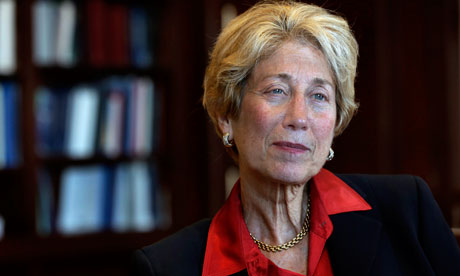
Read what Judge Shira Scheindlin fights for from this The Guardian article:

***

Image Source: theguardian.com
A US judge has asked an appeals court to reinstate her to a closely watched case regarding the constitutionality of the New York police department's "stop-and-frisk" tactic, saying she was unfairly removed from it a week ago.

In a highly unusual request, US District Judge Shira Scheindlin asked the 2nd US circuit court of appeals to reverse its ruling of 31 October when a three-judge panel removed her from the case, saying she "ran afoul" of the judicial code of conduct in part by granting media interviews.

Two months ago Scheindlin became a hero of civil rights and civil liberties groups when she struck down parts of stop-and-frisk, ruling that it amounted to "indirect racial profiling" that resulted in the disproportionate and discriminatory stopping of black and Hispanic people.

In that ruling she also appointed a federal monitor to oversee changes in NYPD practices.

The city appealed and the appeals court ruling last week to remove her from the case and to freeze her decision was at least a temporary victory for Mayor Michael Bloomberg and the NYPD. The city has argued that stopping, questioning and frisking suspicious people has led to a steep decline in crime rates.
The issue played a role in the campaign for mayor of New York City in which candidate Bill de Blasio, who won in a landslide on Tuesday, blasted stop-and-frisk as unfair.

The three-judge panel's ruling had no implications for the merits of the case and instead was a rebuke of Scheindlin. The judges said they would rule on the merits of the case upon hearing the city's appeal of Scheindlin's ruling next March.

Scheindlin, in the motion filed on Wednesday by her attorney, Burt Neuborne, noted that the judge had never been accused of running afoul of the code of conduct by any of the parties in the case at the district court level, nor in oral arguments before the appeals court.

Moreover the appeals court should have notified Scheindlin in advance that it intended to disqualify her and she should have been given a chance to respond before the ruling was made, her lawyer said in the court brief.
"Since nobody asked for her disqualification, and the disqualification came from the court itself, this is her chance to ask: 'Before you do this to me, let me at least get a chance to explain myself,'" Neuborne told Reuters.

***
More legal issues and updates can be found in this Atty. Evan Granowitz Facebook page.

Saturday, October 19, 2013

REPOST: Toronto paying millions in lawsuit claims

This online article talks about the different civil lawsuits faced by the City of Toronto over the years, with "slipping and falling on public property" as one of the biggest categories. Read more:

***
The City of Toronto has spent more than $200 million to settle civil lawsuits since 2000, and the payouts are getting richer, a municipal database obtained by the Star shows.
Litigants range from people alleging they were struck by golf balls to prisoners claiming they were assaulted in police custody.
The largest payment, for $4,454,909.69, stems from a 2001 incident in which a lifeguard was alleged to be at fault. The city did not release details of the case, or of any of the 3,062 settlements contained in the database. Many of the cases are covered by confidentiality agreements.
Almost one in four of the total tally — 773 — were related to road and sidewalk maintenance. Those settlements totaled $32,458,390.50.
The city’s response to inclement weather accounted for 640 lawsuits. On incident involving an icy driveway cost the city $439,345.74.
Police activity has resulted in at least 256 settlements, worth more than $27 million. That includes dozens of cases of use of force, false arrest and negligent investigation.
The city “self-insures” for all claims under $5 million — meaning it pays the claims with city money — and maintains a reserve fund to cover claims. The city buys insurance coverage to handle claims worth more than $5 million. Any claims that large would not show on the database.
Image Source: thestar.com
Shelley Carroll, who served as city budget chief from 2006 to 2010, said poor city services were partly to blame for the number of settlements.
“We’ve privatized the repair of the sidewalks that people are going to trip on,” she said.
“At a certain point do we have to ask ourselves: do we want prettier sidewalks … do we want to pay it out in the settlement — or fund it properly in the first place?”
Carroll added that the total cost of the settlements didn’t seem high.
“Two hundred million over the time span you’re looking at is not unreasonable … By and large we have reasonable lawsuits. We don’t have a nutty, litigious society like the United States.”
The number of settlements per year has not being growing — in fact, it has declined slightly — but the likelihood of getting a large settlement has increased. All five of the years with the highest average settlement have come since 2007. That includes three years — 2008, 2011, and 2012 — with an average settlement greater than $100,000. (The average for the past fourteen years, including so far in 2013, is just over $60,000.)
But Carroll said it wouldn’t be worthwhile to try to curb the amount paid in settlements.
“It’s kind of a mug’s game to set a dollar amount, because when you pay a big settlement for a good reason, it goes out the window.”
The database, which the Star obtained through a Freedom of Information request, shows the reasons the city pays out settlements in civil cases.
  • Slipping and falling is more likely to land you a settlement than tripping and falling: slips have resulted in 140 settlements, costing the city $5,230,771.35; trips have resulted in 107 settlements worth $4,657,259.75.
  • Beware the trees: arboreal misadventures are to blame for 57 settlements costing about $1.5 million. That includes 21 for trees that caused bodily injury and 36 for trees that caused property damage, though the portion of data obtained by the Star does not include descriptions of the incidents.
  • The city has paid settlements in 33 cases of discrimination leading to personal injury, amounting to $1,833,575.88.
  • The city has also settled 22 human rights complaints, including two for more than $200,000.
  • City vehicles, meanwhile, seem to engage in their fair share of bad driving, having led to 186 settlements worth almost $22 million, including 35 incidents of pedestrians being struck by city vehicles.
  • It isn’t clear what kinds of city vehicles have been involved in the collisions — whether police cars, snow plows, or TTC buses and streetcars. But the 24 settlements caused by a city vehicle entering intersections against the light suggests fire trucks and ambulances, which often run red lights.
  • The city has made 20 payouts over $1 million since 2000. 414 settlements were for six figures or more.
  • More than half of the money paid by the city in settlements is for “bodily injury”: $112,394,033.06 out of a total $202,350,522.41
  • In 2005, someone recouped a $25,000 bodily injury settlement from the city after being hit with a golf ball.
  • A 2002 sewer backup won the claimant more than $2.5 million for lost property alone. (It’s one of 92 settlements for sewer backups, totaling $6,365,371.98).
  • Legal costs also eat up a large proportion of the city’s settlement budget: more than $57,000,000 since 2000, or more than a quarter of the total cost of settling civil lawsuits incurred by the city in that time.
  • In 88 cases, the city had legal expenses in the six figures.

  • ***
    More updates on the legal sector can be read on this Evan Granowitz Facebook page.